When (and by whom) did the term 'substitionary atonement' become widely used?
4
votes
2
answers
121
views
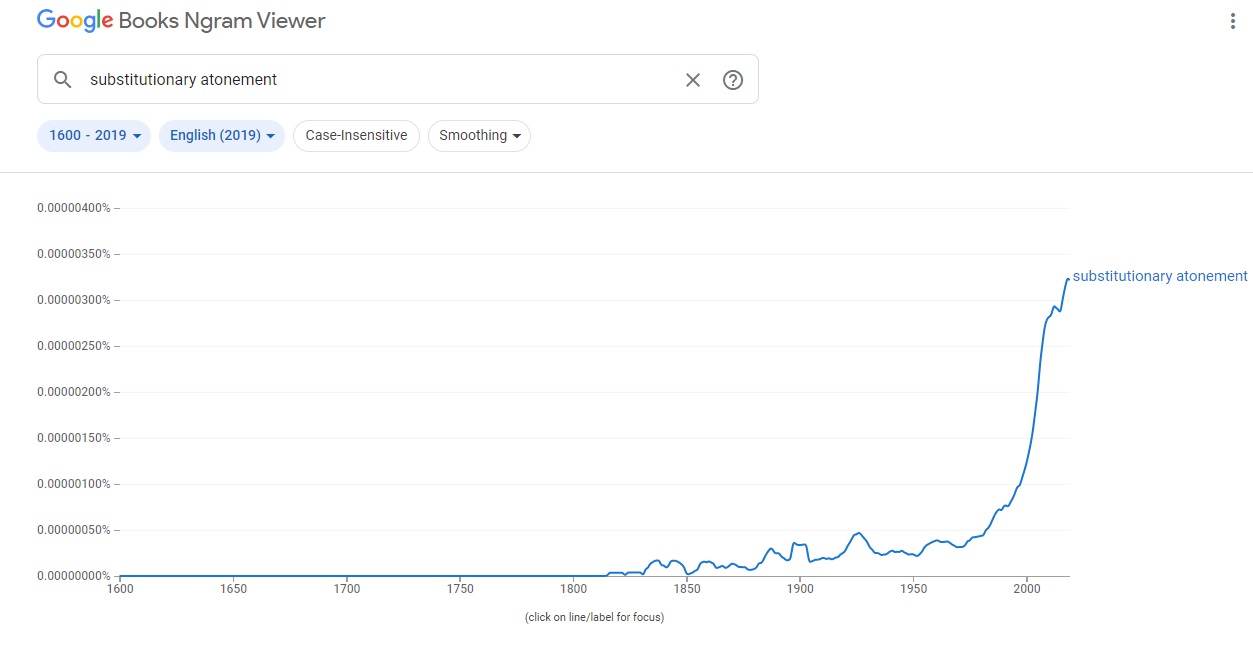
I was very surprised when I entered the words 'substitutionary atonement' into the Google Ngram Viewer and produced the graph below.
The graph shows usage in literature from 1600 to 2019.
This reports from the corpus thus far digitally scanned into Google Books.
This is a fairly reliable representation of the usage of language. And this appears to indicate that the phrase is a relatively modern phenomenon. The fact that its heavier usage begins in the mid 1850s might point to rising usage in the beginnings of the Brethren movement - the 'Plymouth Brethren' at the time.
It could also denote usage among the rising Baptist movement - the 'Strict Baptists' (as opposed to 'Anabaptists') of the time.
But what surprises me is that it appears not to be terminology used either by the Reformers or by the Puritans.
And certainly not from the early Church.
Does anyone have any more information on its first usage and first popularity - or why it seems to have gained significant usage in the past few years ?
 Link to the Ngram Viewer
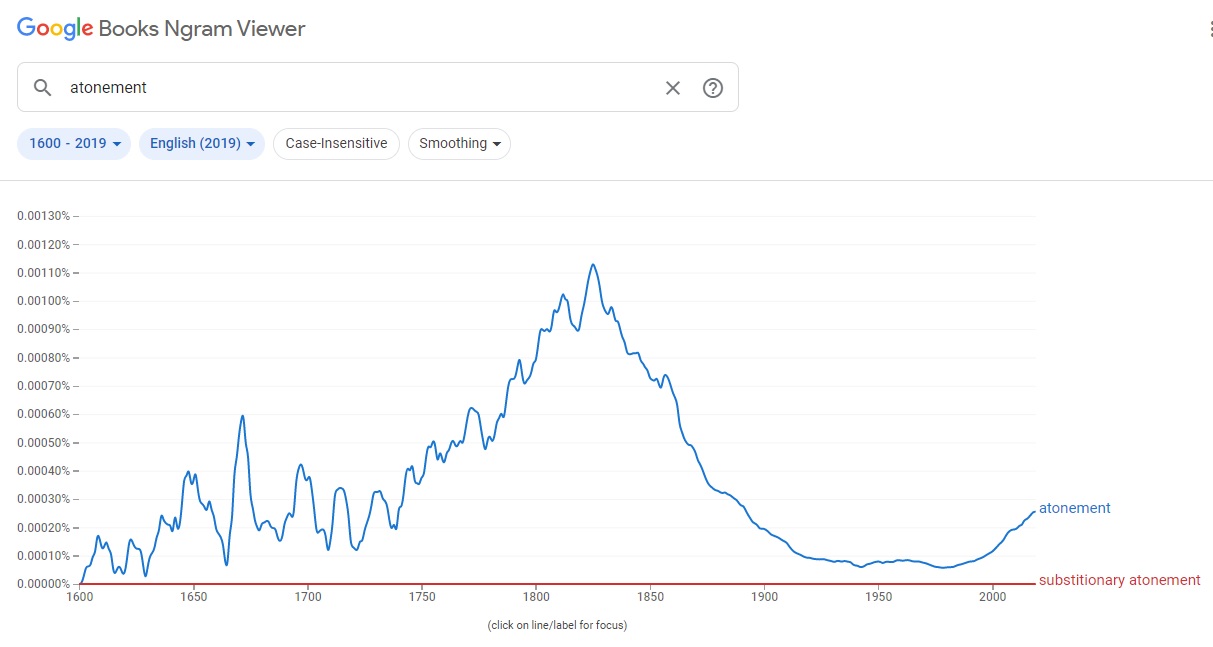
As per the comment, I have added the Ngram for 'atonement' and its usage far outweighs that of 'substitionsary atonement' (to the point of flattening its curve to zero) but shows an increase, also, in the past few years.
Link to the Ngram Viewer
As per the comment, I have added the Ngram for 'atonement' and its usage far outweighs that of 'substitionsary atonement' (to the point of flattening its curve to zero) but shows an increase, also, in the past few years.
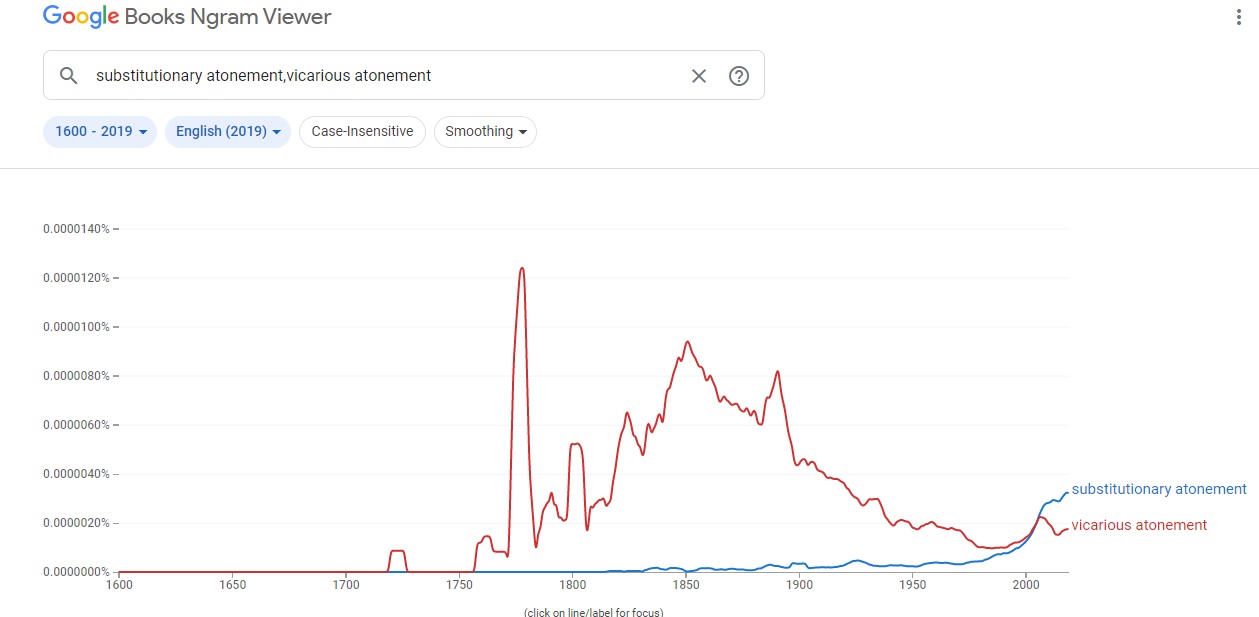
 As per the second comment, I have plotted 'vicarious atonement' against 'substitutionary atonement'. Very interesting indeed.
Link to the Ngram Viewer
As per the comment, I have added the Ngram for 'atonement' and its usage far outweighs that of 'substitionsary atonement' (to the point of flattening its curve to zero) but shows an increase, also, in the past few years.
As per the second comment, I have plotted 'vicarious atonement' against 'substitutionary atonement'. Very interesting indeed.
Asked by Nigel J
(29730 rep)
Jun 2, 2022, 01:52 PM
Last activity: Apr 18, 2026, 09:04 PM
Last activity: Apr 18, 2026, 09:04 PM